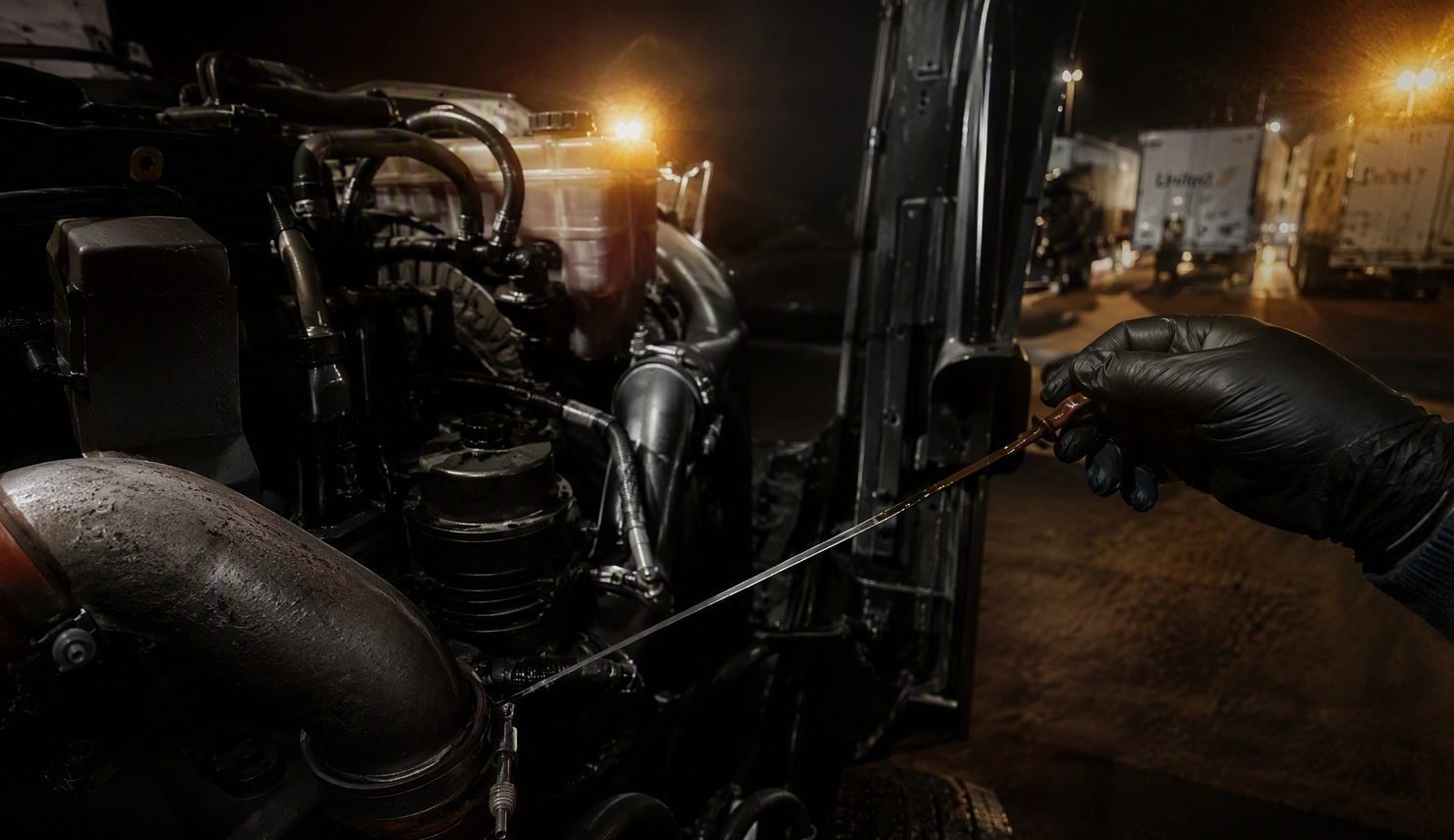
It's 3:07 in the morning. My phone rings, and it's Marcus, running a 53-foot dry van full of restaurant supply down I-81 outside Harrisburg. Trailer tire let go, chunked the tread across two lanes, and the state trooper who stopped to "help" decided the scene needed a full roadside inspection. Marcus failed it. Not on the tire — on a chafed brake hose and a logbook gap from Tuesday. So now the load's sitting on the shoulder, the receiver's going to back-charge us for a late dock window, and I've got a driver who did nothing wrong except trust that the trailer got looked at before dispatch. That's the night this page comes from. If you run trucks, a DOT inspection isn't a hypothetical. It's a Tuesday. And most fleets fail them for reasons that would've cost forty dollars and fifteen minutes to fix.
Here's what I tell every owner-operator who calls me after the fact: the inspectors are not out to get you. They're out to check boxes, and the boxes are published. The whole game is knowing which boxes, at which level, and having your truck and your paperwork ready before the flares come out. Let's walk all six levels, then the checklists, then the paperwork that actually gets drivers parked.
The Six DOT Inspection Levels
The Commercial Vehicle Safety Alliance (CVSA) defines six levels of roadside inspection under the North American Standard Inspection Program. Every trooper, every FMCSA inspector, every state enforcement officer running a scale house works off this same playbook. You should know it better than they do, because you're the one whose CSA score bleeds when they find something.
Level I — North American Standard Inspection
This is the full monty. Driver and vehicle, top to bottom, including crawling underneath the rig. The Level I is a 37-step procedure and it runs 45 to 60 minutes if the inspector is thorough and you're not arguing. They'll check the driver's license, medical certificate, hours-of-service records, and seat belt use, then go over the truck: brakes, tires, wheels, rims, hubs, steering, suspension, frame, fuel system, exhaust, lights, reflectors, electrical, coupling devices, cargo securement, windshield wipers, the works. Underneath the vehicle is where most of the pain lives — brake adjustment, air leaks, cracked frames, worn bushings.
Level I is the most common inspection level on the road, and it carries an out-of-service rate hovering around 15 percent in a normal enforcement year. Think about that. One truck in seven that gets a full inspection gets parked right there. If your fleet gets pulled into ten Level I inspections a year, statistically you're losing a truck and a load at least once. That's not bad luck. That's math telling you your maintenance program has holes.
Level II — Walk-Around Driver/Vehicle Inspection
Level II is the Level I minus the crawl. The inspector walks around the vehicle and checks everything that's visible without physically getting underneath it, and they still do the full driver portion — license, med card, HOS, the whole document stack. It takes 20 to 30 minutes typically. Because nobody's sliding under the frame, it misses things like brake chamber condition and air line chafing, which is exactly why the OOS rate drops to about 10 percent. Don't let that comfort you. A Level II still finds lighting violations, tire violations, and obvious securement problems, and the driver portion is identical. If your driver's paperwork is a mess, a Level II parks him just as dead as a Level I.
Level III — Driver/Credential/Administrative Inspection
Driver only. No truck portion at all. The inspector checks the CDL, the medical examiner's certificate, hours-of-service documentation, the record of duty status (RODS — your ELD output or paper log), seat belt, and any applicable endorsements and hazmat paperwork. Fifteen to twenty minutes, usually at a scale house or a weigh station bypass pull-in. The vehicle OOS rate is basically irrelevant here — around 5 percent of Level III inspections end in a driver being put out of service — but the violation rate tells the real story. Roughly 25 percent of Level III inspections turn up an hours-of-service violation. One in four. That's 49 CFR Part 395 doing what it does: the 11-hour driving limit, the 14-hour window, the 30-minute break, the 60/70-hour weekly caps. ELDs made falsifying logs a lot harder, so now the violations are honest ones — drivers who genuinely ran out of hours and rolled anyway because dispatch said the load couldn't wait. Dispatch is never the one sitting on the shoulder.
Level IV — Special Inspection
Level IV is the odd one. It's a one-time examination of a particular item, usually run to support a CVSA study or to verify a trend — like a focused look at brake defects across a sample of trailers, or a check of a specific component a manufacturer flagged. It's not about your whole truck and it's not about your driver. There's no standard OOS exposure unless the inspector actually finds a defect in the item being studied, in which case normal out-of-service criteria apply. You can't prepare for a Level IV specifically because you don't know it's happening. What you can do is keep your brake systems boring. Boring brakes never make the studies.
Level V — Vehicle-Only Inspection
Same vehicle portion as a Level I, but no driver present and no driver paperwork. This one usually happens at a terminal, a carrier's yard, or a port — an inspector shows up where the equipment lives. It runs 30 to 45 minutes per unit. Fleets see Level V inspections during compliance reviews and at intermodal ramps where containers and chassis get checked while drivers are off at the dispatch window. The trap here is that nobody's standing next to the inspector to explain anything, so the truck has to speak for itself. A handwritten note saying "shop on Monday" does not fix a slack adjuster that's out of stroke today.
Level VI — Enhanced NAS Inspection for Radioactive Shipments
Level VI is the specialist: it applies to transborder shipments of radioactive material — select Highway Route Controlled Quantities of radioactive material moving across the Canadian or Mexican border. It includes radiological checks on top of the full North American Standard procedure, and it's conducted by specially trained and certified inspectors. If you don't haul radiological freight across a land border, Level VI will never touch you. If you do, you already know — your shipper's contract spells it out, and the inspection happens before departure, not roadside. Everyone else can stop worrying at Level V.
Fast memory trick: Level I is everything including underneath. Level II is everything except underneath. Level III is just the driver. Level IV is just one thing. Level V is just the truck. Level VI is nuclear freight at the border. Say it once and you'll never mix them up on a quiz, a compliance review, or a roadside shoulder.
The Pre-Trip Checklist That Actually Passes Inspections
49 CFR 396.13 requires the driver to be satisfied the vehicle is in safe operating condition before driving it. Every driver "does a pre-trip." Most pre-trips are a walk around the truck at diesel-pump speed with the coffee still in hand. That's not a pre-trip; that's a lap. A pre-trip that survives a Level I has ten points, and each one maps directly to the violation categories that park trucks. Here they are, in the order I'd fire a driver for skipping:
- Tires. Tread depth, inflation, sidewall damage, and — this is the one that killed Marcus — mismatched or regrooved rubber on the wrong axle. Steer tires need 4/32-inch minimum tread; everything else needs 2/32. Check it with a gauge, not a boot.
- Brakes. Air leaks you can hear, gladhand seals, hose chafing where lines rub the frame, and pushrod travel at each chamber. Out-of-adjustment brakes are the single biggest OOS category in North America.
- Lights and conspicuity. Every lamp, every reflector, every piece of tape on the trailer sides and rear. A two-dollar marker light is a violation. A dead brake light is an invitation.
- Fluids. Oil, coolant, power steering, DEF, and evidence of leaks underneath — fresh drips on the ground where the truck sat overnight tell you more than any gauge.
- Coupling. Fifth wheel locked around the kingpin, safety latch engaged, jaws visually confirmed, air lines and electrical cord seated and secured. Dropped trailers don't happen to fleets that tug-test.
- Cargo securement. 49 CFR 393 Subpart I. Straps without edge cuts, chains without stretched links, binders locked, load can't shift. Inspectors can see a lazy strap from forty yards.
- Emergency equipment. Fire extinguisher charged and mounted, three reflective triangles, spare fuses. Yes, fuses — carrying them is a federal requirement, and it's the cheapest compliance item in the book.
- Documents. CDL, medical certificate, registration, insurance card, IFTA credentials, and any permits, all in the cab, all current, all findable in under a minute.
- Hours of service. Enough hours on the clock to actually make the run legally under Part 395, and the ELD working before the wheels move, not after the first scale.
- DVIR review. The driver must review the last driver vehicle inspection report on the vehicle and confirm reported defects were repaired. Signing blind is how yesterday's defect becomes today's OOS.
Run that list in fifteen honest minutes and you'll beat the 15 percent OOS average before the inspector even introduces himself.
Post-Trip Inspection and the DVIR Rules Nobody Reads
The pre-trip gets all the attention, but the post-trip is where fleets quietly die. 49 CFR 396.11 requires the driver to prepare a report — the Driver Vehicle Inspection Report — at the end of each day's driving on each vehicle operated, listing any defect or deficiency discovered or reported that would affect safety or cause a breakdown. The regulation names the equipment categories explicitly: service brakes including trailer brake connections, parking brake, steering, lighting devices and reflectors, tires, horn, windshield wipers, rear vision mirrors, coupling devices, wheels and rims, and emergency equipment.
Same ten points as the pre-trip, run at the end of the day instead of the start — plus the paperwork. And the paperwork is the part with teeth. When a driver reports a defect, the motor carrier must repair it (or certify it doesn't need repair) before the vehicle operates again, and the next driver has to sign acknowledging the repair was made. Carriers must keep the original DVIR and the certification of repairs for three months. FMCSA gave single-unit trucks a break a few years back — no-defect DVIRs aren't required for them — but combination vehicles still run the full loop, and I'd argue every fleet should anyway, because the DVIR trail is the first thing an auditor pulls in a compliance review. It's your proof you knew about problems and fixed them. Without it, you're just a fleet that didn't know, and "didn't know" is not a defense; it's an admission.
What a missed DVIR actually costs: an OOS order strands the truck on the spot, the driver burns hours waiting for a road-service truck, and the violation posts to your CSA SMS data where it sits for 24 months dragging your BASIC percentiles up. Towing, road call, missed delivery, late fees, and a score hit that raises your insurance premium at renewal. I've watched a $60 brake hose turn into a $9,000 week. Write the report. Fix the hose.
The Driver Qualification File: Six Documents Between You and a Shutdown
Under 49 CFR 391, every driver you put behind the wheel needs a Driver Qualification File, and inspectors and auditors treat a thin DQF like blood in the water. Here's what has to be in it:
- Employment application — a real one, meeting 391.21 content requirements, not a one-page name-and-phone-number card.
- Road test certificate — proof the driver was actually road-tested in the type of equipment they'll run, or the accepted equivalent (a valid CDL of the right class covers it for most hires).
- Medical examiner's certificate — current, from an examiner on the National Registry, and you need to verify the registry entry. Expired med cards are the single dumbest way to get a driver disqualified.
- Annual motor vehicle record — pulled every 12 months from every state that held the driver's license, plus an annual review and the driver's own annual certification of violations.
- Safety performance history — the inquiry to previous employers covering the last three years, including drug and alcohol history, with documented good-faith effort if a former employer stonewalls you.
- Retention discipline — keep the qualification documents for the length of employment plus three years after the driver leaves. The safety performance history inquiries get the same three-year clock. Purge wrong and an auditor assumes you were hiding something.
Owner-operators, listen: if you lease onto a carrier, they hold your DQF, but if you run under your own authority, you are the carrier. You have to maintain a file on yourself. Yes, you have to pull your own MVR annually and write yourself a review note. It feels ridiculous. Do it anyway. The auditor will not think it's ridiculous.
What Actually Puts Trucks Out of Service
Everybody guesses at this. The data isn't a guess. Year after year, the same four categories dominate out-of-service orders at roadside, and the split barely moves. Here's the breakdown I plan around:
| Violation Category | Share of OOS Orders | What It Looks Like in the Yard |
|---|---|---|
| Brake systems | ~32% | Out-of-adjustment slack adjusters, chafed or kinked air lines, audible leaks at gladhands, worn linings past minimum thickness |
| Lighting and conspicuity | ~22% | Dead marker lamps, inoperative brake lights, missing or peeling reflective tape, cracked lens housings |
| Tires and wheels | ~18% | Tread under 4/32 on steers or 2/32 elsewhere, sidewall bulges, exposed cord, flat or underinflated duals touching |
| Hours of service | ~15% | Driving past the 11-hour limit, no 30-minute break, missing RODS, ELD malfunctions never addressed |
Read that table again. Roughly two-thirds of all OOS orders are brakes, lights, and tires — three systems a driver can physically touch on a walk-around. HOS adds another chunk that lives entirely in the driver's own decisions. This is why I lose my mind when a fleet spends money on a new telematics dashboard before it buys a tread-depth gauge and a case of marker lamps. The technology is fine. The failure is mechanical and boring, and it's preventable with a flashlight.
One more number that should scare you: a vehicle OOS violation doesn't just park that truck. Under CSA, vehicle maintenance violations hit your SMS at up to 10 severity points each depending on the defect, weighted again by time and crash relevance. Two bad inspections in a quarter can push a small carrier past the intervention threshold, and then you're not dealing with a trooper anymore — you're hosting an FMCSA audit team.
CVSA International Roadcheck: 72 Hours of Maximum Attention
Once a year, CVSA runs the International Roadcheck — a 72-hour inspection blitz across the United States, Canada, and Mexico. For three days, certified inspectors run high-volume Level I, II, and III inspections at weigh stations, temporary sites, and roving patrols. Tens of thousands of trucks get inspected in a long weekend, and every driver who runs legal suddenly has stories.
The 2024 Roadcheck ran June 4 through 6, and the announced focus areas were tractor protection systems on the vehicle side and controlled substances and alcohol on the driver side. The tractor protection angle matters more than people realize: inspectors were checking that the tractor protection valve works — the component that keeps the trailer's air supply intact and stops the trailer brakes from applying if a line breaks. That's a part most drivers couldn't point to, and CVSA put it on the poster. Meanwhile the drug and alcohol focus leaned on the Drug & Alcohol Clearinghouse — drivers in "prohibited" status got flagged on the spot. Every year the blitz has a theme like this, and every year fleets that ignored the announcement feed the statistics.
Roadcheck week strategy: CVSA announces the dates and focus areas months ahead. Put them on the shop calendar. The week before, every unit gets a full Level I simulation — air system, brakes, lights, tires, securement, and a document audit on every driver including Clearinghouse status. Some fleets park marginal trucks for three days. I'd rather fix them, but parking beats a 72-hour OOS order on a hot load.
How to Prepare So You Stop Getting Woken Up at 3 AM
Preparation isn't a week-of scramble. It's a calendar. Here's the rhythm that keeps my phone quiet:
- Six months out from anything big — a renewal, an audit window, Roadcheck season — run a mock Level I on every unit. Pull the last 90 days of DVIRs and look for patterns: the same trailer reported for the same light three times means nobody fixed it, they just kept signing.
- Spare fuses in every cab. Federally required, costs about four dollars, and the number of drivers who don't carry them is a scandal.
- Tread depth discipline. Pull steer tires at 4/32 — that's the legal floor, not the target — and drive and trailer tires at 2/32. Set your replacement trigger a thirty-second above the legal minimum so a hot summer week doesn't wear you into a violation between PMs.
- No visible brake lining wear, ever. If you can see the lining getting thin through the wheel, the inspector can too, and his threshold is a regulation while yours is a guess. Replace early. Shoes and pads are cheaper than tows.
- Document packets, assembled and sealed. Registration, insurance, IFTA, permits, annual inspection form under 396.17 — in one envelope, in the cab, refreshed quarterly. A driver digging through a trash bag of receipts reads as "this fleet has problems."
- Clean the cab. I'm serious. Inspectors are human. A clean cab, an organized binder, and a driver who greets them like a professional buys a presumption of competence that a pigsty never will. It shouldn't matter. It does.
- Train drivers on the inspection itself. What to hand over, in what order, what the inspector will do at each step of the 37, and the one rule that matters: don't argue roadside. Take the citation, note the disagreement, fight it through DataQs later where it actually counts.
And one more thing, for the owner-operators running one truck and doing everything themselves: you're allowed to build this system cheap. A clipboard, a flashlight, a tread gauge, a fuse kit, a tire thumper, and a binder with six dividers will put you ahead of fleets with forty trucks and a compliance department. The regulation doesn't scale with fleet size. The trooper at the scale doesn't care that you're small. But the fix doesn't scale either — it's still a walk-around and honest paperwork. Do both, and the next 3 AM call you get will be somebody else's fleet manager's problem.
Need a second set of eyes on your inspection prep program before Roadcheck season? Talk to FleetDoc USA