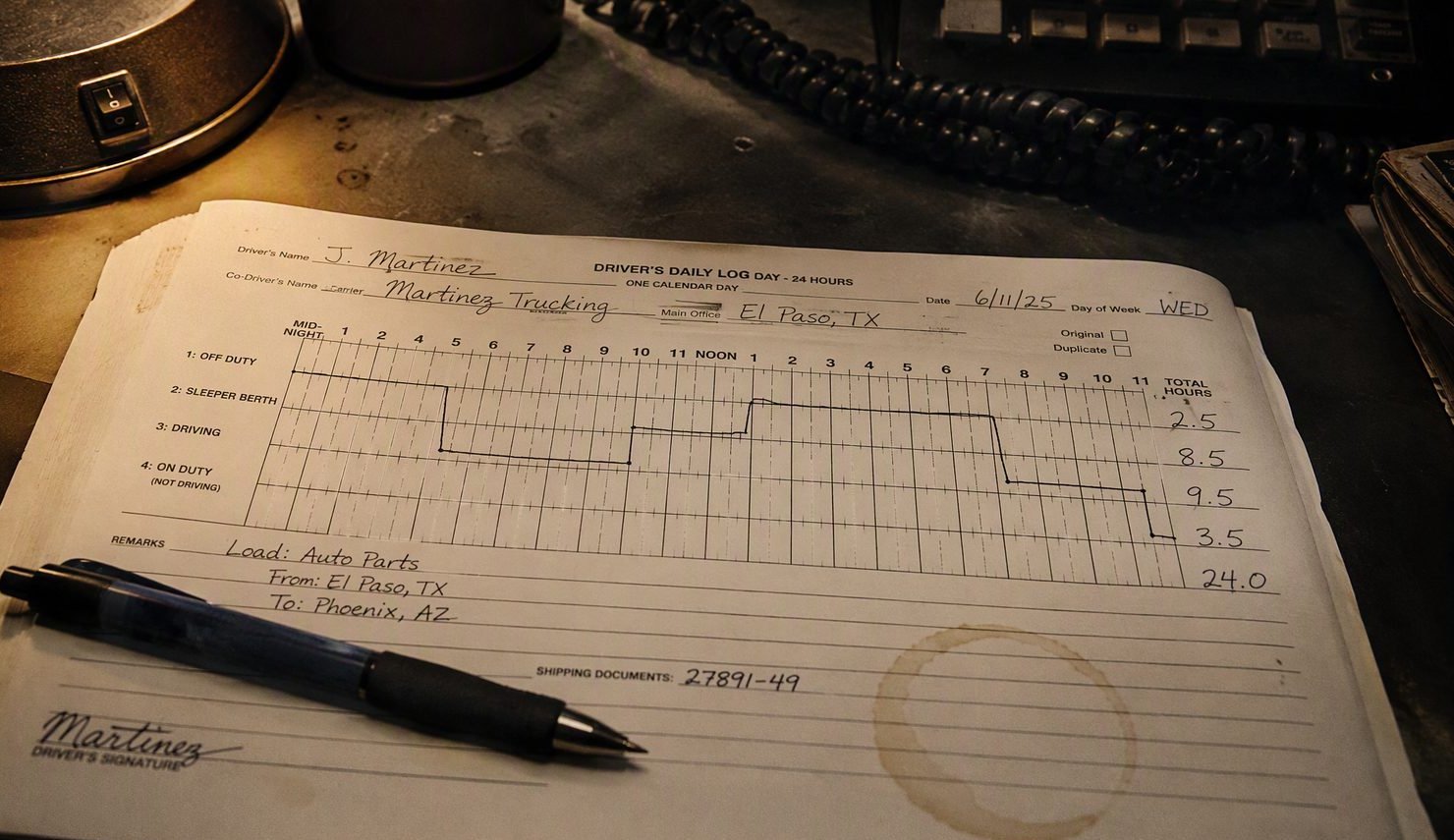
It's 3 AM and I'm staring at a spreadsheet with 41,000 miles on it, a shoebox of fuel receipts fading in the glovebox heat, and a filing deadline that doesn't care that two of my drivers quit last week. That's IFTA. The International Fuel Tax Agreement isn't hard math — it's arithmetic a middle schooler could do — but the record-keeping behind it will eat a small fleet alive if you let it slide for even one quarter. This page is everything I wish somebody had told me before my first audit: what IFTA actually is, what you have to track, how the net tax math works with real numbers, and the specific mistakes that get owner-operators flagged.
What IFTA Actually Is
The International Fuel Tax Agreement is a fuel tax compact between the lower 48 US states and 10 Canadian provinces. Before IFTA, a truck running interstate had to buy a fuel tax permit for every state it rolled through and file separate reports with each one. Carriers were drowning in decals and paperwork. So the states got together and agreed on one license, one set of decals, and one quarterly report filed with your base jurisdiction. Your base state collects the whole thing and settles up with the other jurisdictions behind the curtain. You never see that part. You just file once and pay once.
Here's who it applies to. If you run a "qualified motor vehicle" in two or more IFTA member jurisdictions, you're in. A qualified vehicle is one used in commercial use — designed, used, or maintained for transporting people or property — that meets any of these tests: two axles with a gross vehicle weight or registered gross weight over 26,000 pounds; three or more axles regardless of weight; or a combination (tractor and trailer) where the combined weight tops 26,000 pounds. Your pickup hauling a landscaping trailer to the next county? Not IFTA. Your one-ton dually running freight across a state line under a for-hire authority? Almost certainly IFTA. Recreational vehicles are excluded unless they're used in connection with a business.
And the Canadian piece matters more than people think. Ten provinces — Alberta, British Columbia, Manitoba, New Brunswick, Newfoundland and Labrador, Nova Scotia, Ontario, Prince Edward Island, Quebec, and Saskatchewan — are full members. If you're running loads into Ontario, those kilometers count, and they get converted to miles on your return. Alaska, Hawaii, the District of Columbia, Yukon, Northwest Territories, and Nunavut are non-IFTA jurisdictions. Miles there don't go on the IFTA return, but if you're operating in them, you may need separate trip permits. More on that in the audit section, because it's a trigger.
The whole concept rests on one idea: fuel tax should be paid where the fuel is burned, not where it's bought. You can buy all your diesel at the cheapest truck stop in Texas, but if you burn it climbing grades in California, California wants its money. IFTA is the accounting mechanism that moves the money from where you pumped to where you drove. That's why the entire system is built on two numbers per jurisdiction: miles driven and gallons purchased. Everything else flows from those.
Quarterly Deadlines — Put Them on the Wall
IFTA runs on calendar quarters, and the return is due the last day of the month after the quarter closes. There is no grace period in most jurisdictions, and late filing triggers a flat penalty (commonly $50 or 10% of the tax due, whichever is greater) plus interest that compounds monthly. File late twice in a row and some states start asking whether your license should be renewed at all.
| Quarter | Reporting Period | Return Due |
|---|---|---|
| Q1 | January 1 – March 31 | April 30 |
| Q2 | April 1 – June 30 | July 31 |
| Q3 | July 1 – September 30 | October 31 |
| Q4 | October 1 – December 31 | January 31 |
A zero-activity quarter still requires a return. Truck in the shop all of Q3? File a zero return by October 31. Skip it because "nothing happened" and you'll get a failure-to-file notice, an estimated assessment based on your old quarters, and a headache that takes three phone calls to unwind. And yes, you can file even if you owe nothing or are due a refund — overpaid quarters generate credits that offset future liability, but only if you actually filed.
Miss one deadline and the meter starts running. Most base jurisdictions hit you with the greater of $50 or 10% of net tax due, then interest on top — and interest accrues from the original due date, not from when they bothered to send the letter. A $1,900 quarter filed 90 days late can easily land at $2,200 before anyone at the state even picks up a phone.
What You Have to Track — Every Truck, Every Day
This is where IFTA stops being arithmetic and starts being a discipline problem. For every qualified vehicle, every quarter, you need records that support six categories of data. The return itself just wants totals by jurisdiction, but the totals have to be backed by source documents an auditor can touch.
- Odometer readings by jurisdiction. The odometer reading when the truck enters a jurisdiction and when it leaves it. This is the backbone. Not GPS miles — the physical odometer.
- State line crossings. Date, route, and odometer at each crossing. Most carriers capture this on trip sheets or through an ELD, but it has to tie back to the odometer.
- Total miles. Beginning and ending odometer for the quarter, per truck. The sum of all your jurisdictional miles must equal this number. If it doesn't, you have a gap, and gaps are what auditors eat for breakfast.
- Taxable miles. Usually the same as total miles in a jurisdiction, but not always. Some states exempt certain miles — off-highway use, specific toll roads, miles under a temporary permit. Know the difference per jurisdiction.
- Fuel purchased by state, in gallons. Every receipt, every card swipe, broken out by where the fuel physically went into the tank. Gallons, not dollars. A receipt that shows only a dollar amount is a problem receipt.
- Fuel consumed by state, in gallons. This is a calculated number, not a measured one: miles in the jurisdiction divided by your fleet's miles-per-gallon. It's where the math section below comes in.
Receipts have their own rules. A valid IFTA fuel record shows the date of purchase, the seller's name and address, the number of gallons, the fuel type, the price per gallon, and the vehicle or unit number. A credit card slip that says "FUEL $412.00" with no gallons and no location is worth approximately nothing in an audit. Train your drivers to ask for the printed pump receipt every single time, and to photograph it before it fades — thermal paper in a hot cab is illegible in six weeks.
Make the odometer photo a habit. Have drivers snap a phone photo of the odometer at every state line and every fuel stop. Timestamped, geotagged, unarguable. When the auditor asks how you know Truck 7 crossed into Pennsylvania at mile 118,442, you don't explain — you show the picture. Costs nothing, ends arguments.
Tax Rates — Every Jurisdiction Sets Its Own
There is no single IFTA rate. Each jurisdiction sets its own per-gallon rate, and they change — some states adjust annually, some twice a year, a few index them to fuel prices or inflation. IFTA Inc. publishes the consolidated rate matrix every quarter, and you are expected to use the rates for the quarter you're filing, not the quarter you're in. Using last quarter's rates because you already had the spreadsheet open is a real error I've watched a carrier pay for.
To give you the flavor, here are example diesel rates from the 2024 Q2 matrix. These are illustrations of the spread, not a filing document — always pull the current matrix from your base jurisdiction's portal or IFTA Inc. before you calculate.
| Jurisdiction | Example Diesel Rate (2024 Q2) | What That Means per 1,000 Gallons |
|---|---|---|
| California | $0.588 / gal | $588.00 |
| Texas | $0.20 / gal | $200.00 |
| Illinois | $0.487 / gal | $487.00 |
| New Jersey | $0.175 / gal | $175.00 |
Look at that spread. California's rate is more than three times New Jersey's. That's why smart fleets buy fuel where the tax is low even if the pump price looks a hair higher — the pump price includes the tax, and the tax follows the miles, not the purchase. A diesel gallon bought in NJ at $0.175 tax and burned in CA at a $0.588 obligation means you owe California the $0.413 difference on every one of those gallons. The total-cost-of-fuel game is a tax-arbitrage game, and it's completely legal because that's exactly how the agreement was designed to work.
The Net Tax Calculation — A Worked Example
Here's the whole engine, and it fits on an index card. For each jurisdiction you operated in during the quarter:
- Gallons consumed in the state = total miles driven in that state ÷ your fleet MPG for the quarter.
- Net tax owed to the state = (gallons consumed × that state's rate) − (gallons purchased in that state × that state's rate).
If the number is positive, you owe that jurisdiction. If it's negative — you bought more fuel there than you burned — you get a credit against what you owe elsewhere. Sum every jurisdiction's net and that's the check you write with your return (or the credit you carry). One fleet-wide MPG is used for the whole quarter across all vehicles in most base jurisdictions; some let you file per-vehicle MPG. Check your base state's rules.
Now the real numbers. Say you run a five-truck fleet, quarter total of 82,000 miles, and your fleet averaged 6.5 MPG. Total gallons consumed for the quarter: 82,000 ÷ 6.5 = 12,615.4 gallons. Here's the quarter broken down:
| Jurisdiction | Miles | Gallons Consumed (÷6.5) | Gallons Purchased | Rate | Net Tax |
|---|---|---|---|---|---|
| California | 4,550 | 700.0 | 200 | $0.588 | +$294.00 |
| Texas | 19,500 | 3,000.0 | 4,100 | $0.20 | −$220.00 |
| Illinois | 6,825 | 1,050.0 | 900 | $0.487 | +$73.05 |
| New Jersey | 9,100 | 1,400.0 | 1,200 | $0.175 | +$35.00 |
Walk California: 4,550 miles ÷ 6.5 MPG = 700 gallons burned. You only bought 200 gallons in California, so 500 gallons of tax were never paid at the pump. 500 × $0.588 = $294.00 owed. Now Texas: you burned 3,000 gallons but bought 4,100 — you overbought by 1,100 gallons, so Texas owes you 1,100 × $0.20 = $220.00 back. Illinois nets +$73.05, New Jersey nets +$35.00. Sum it: 294.00 − 220.00 + 73.05 + 35.00 = $182.05 due with the return.
That's it. That's the terrifying document people pay services $400 a quarter to produce. The calculation was never the hard part — proving that 4,550 California miles number, two years from now, to an auditor with a highlighter, is the hard part. The math is arithmetic. The records are the job.
One more wrinkle: a negative fleet-wide total doesn't mean the state mails you a check. Credits typically carry forward to future quarters — some jurisdictions carry them for up to eight quarters before they'll cut a refund, and a few never cut one at all, they just keep applying it. Don't deliberately overbuy fuel to "bank" credits unless your base jurisdiction is one of the ones that actually refunds. That's cash parked in a state treasury earning them interest, not you.
The IFTA License and Decals
You apply for the IFTA license through your base jurisdiction — the state or province where your qualified vehicles are based, where you maintain operational records, and where the vehicles actually return. New Jersey carriers go through the NJ Division of Taxation's Motor Fuel Tax section. One license covers the whole fleet, but each truck gets its own set of decals, and I mean a set: one decal displayed on each side of the cab, exterior, visible. One decal on the driver's side only is a citable violation at a scale house, and running with no decals is a fine plus a possible order to buy a temporary fuel permit on the spot.
The license renews annually, by December 31, for the following calendar year. Miss the renewal window and you can be legally dead in the water on January 1 — some states let you run into the new year on the prior decals with proof of timely renewal application, but don't build your compliance plan on a grace period. Order decals for every truck you might operate, plus a couple of spares. A truck that enters service in March needs its own set; you can't transfer decals between vehicles, and photocopies are worth less than the paper they're printed on.
Keep a copy of the license in every cab. The original stays at your base of operations with your records. And if you add trucks mid-year, you add decals mid-year — the application fee is per-set and it's trivially cheap compared to the citation.
Decals are per-truck, per-year, both sides of the cab. I've watched a driver get pulled out of the line at a weigh station on I-80 because last year's decal was still on the passenger side. Fifteen minutes of arguing, a fine, and a note in a file that follows your DOT number. Swap the decals in December, both sides, every truck, photograph each one.
The Common Errors That Cost Real Money
After enough quarters and one audit, the failure patterns stop being mysterious. Here are the ones that actually hurt carriers, in roughly the order I see them:
Using GPS miles instead of odometer miles. GPS distance calculations run 3–5% off the physical odometer — terrain modeling, signal drift, the way the software handles tunnels and urban canyons. That variance doesn't sound like much until an auditor applies it across 82,000 miles and four jurisdictions and decides your whole return is unreliable. IFTA's own record-keeping standard is built on the odometer. GPS is fine as a supporting source for where the truck was, but the miles on the return should reconcile to the odometer, period.
Missing fuel receipts. You must keep fuel records for four years from the due date or filing date of the return, whichever is later. Same retention window as the mileage records. "The driver lost them" is not a defense; it's a confession. Unsubstantiated purchases get disallowed, which inflates your gallons-consumed-versus-purchased gap, which converts directly into tax, penalty, and interest. Scan receipts weekly. Weekly. Not at the end of the quarter when half of them are blank white slips.
Forgetting fuel purchased but not consumed. Fuel you bought this quarter but didn't burn sits in the tank and rolls into next quarter's math. The credit for overpurchasing in a state carries forward — it doesn't vanish. Carriers doing this by hand regularly either double-count it (audit problem) or drop it entirely (you just donated money to a state treasury). Track tank inventory at quarter boundaries if your fleet is big enough for it to matter.
Wrong state assignment at border crossings. The rule of the road: use the odometer at the sign — the literal "Welcome to Pennsylvania" sign — not a GPS geofence polygon. Geofences drift, boundaries in the software don't always match the physical line, and a truck idling at a shipper two hundred yards across the border can get assigned to the wrong state entirely. Two hundred miles assigned to Ohio instead of Pennsylvania at different rates, across a fleet, across a year, is real money in both directions, and mismatched assignment between consecutive trip records is a red flag auditors are specifically trained to chase.
Reconcile monthly, file quarterly. Thirty minutes at the end of each month tying odometer totals to fuel card totals means the quarterly filing takes an afternoon instead of a week. The carriers who suffer are the ones who do thirteen weeks of archaeology every deadline.
What Triggers an Audit
IFTA requires each member jurisdiction to audit a percentage of its licensees every year, so some audits are pure lottery. But the selection algorithms lean hard on anomalies, and the anomalies are well known:
- Fleet MPG under 5.0 or over 10.0. A loaded Class 8 tractor-trailer lives between roughly 5.5 and 8. Report 4.2 and they assume you're under-reporting fuel purchases. Report 10.8 and they assume you're over-reporting miles or running unqualified vehicles into the calculation. Either way, expect a letter.
- Miles in a non-IFTA jurisdiction with no trip permit. Run Alaska or DC miles on your internal records with nothing showing a permit, and the question becomes what else you're not documenting.
- Bulk fuel purchases with no bulk storage license. Big untaxed or tax-paid bulk draws on your fuel records with no corresponding storage license on file is one of the fastest routes to a full records examination. Dyed diesel showing up in an on-road fleet's math is the nightmare version of this.
- Consecutive quarters with the exact same MPG. Real fleets drift — winter blend, loads, terrain, idle time. 6.50 MPG for four straight quarters tells the computer the number was reverse-engineered from the fuel totals instead of measured from the miles. Never smooth your numbers. Real, slightly ugly data is the best audit armor there is.
And once you're in an audit, understand the stakes: the auditor can go back the full retention period — four years — and can recompute every return. If your records are deemed inadequate, some jurisdictions will assess based on an industry-standard MPG applied to your estimated miles, and that estimate will not be generous. The penalty stack on a bad multi-year assessment has put single-truck operators out of business. I'm not being dramatic. I've seen the letters.
"Inadequate records" is a verdict, not a request. If the auditor decides your mileage or fuel documentation doesn't meet the standard, they don't send you home to fix it — they reconstruct your liability using their assumptions, assess the difference plus penalty plus interest, and your appeal options narrow fast. Four years of clean scans beats four years of excuses every single time.
Spreadsheets vs. ELD-Integrated Software
Manual IFTA on a spreadsheet works — I did it for years — but know what you're signing up for. Every quarter you're hand-keying odometer jumps, matching receipts to states, converting any Canadian kilometers, pulling the current rate matrix, and checking that jurisdictional miles sum to the odometer total. For a five-truck fleet that runs interstate every day, that's a realistic 8 to 12 hours per quarter, and every keystroke is a chance to transpose a digit. The spreadsheet doesn't know you typed 4,055 instead of 4,550. The auditor might.
ELD-integrated IFTA software pulls the odometer readings and state-line crossings straight off the truck's ECM and GPS, matches fuel card transactions by location and gallons, computes MPG continuously, and spits out the return pre-filled by jurisdiction. Cost runs $15–$40 per truck per month depending on the platform and whether it's bundled with your ELD service, and the quarterly labor drops to 1 to 2 hours — mostly reviewing exceptions, orphaned fuel purchases, and trucks with gaps.
So do the math for your own operation. At five trucks, software is maybe $100–$200 a month. Manual is two full working days of somebody's time, four times a year, plus the error rate. My line: one truck running regional, a disciplined spreadsheet and a fuel card with state breakdowns is fine. Three trucks or more, or anything running coast to coast, and the software pays for itself in the first audit it helps you survive — or the first penalty letter you never get.
But — and this is the part the sales decks skip — software does not fix bad inputs. If a driver fuels with cash and loses the receipt, the system has a gallon gap. If a truck's odometer feed drops for two weeks, the system has a mileage gap. Automation turns IFTA from an archaeology project into a review process. It doesn't make the records optional, and the "the software handles it" defense has never once impressed an auditor.
The New Jersey Wrinkle: MFC-1
If you're based in New Jersey, there's a state-specific trap that catches carriers who think IFTA covers everything. New Jersey imposes its own motor fuel tax administration through Form MFC-1, and carriers based in NJ with more than 50% of their total miles in New Jersey may still have an NJ filing obligation even though they're fully IFTA-licensed. The logic: IFTA is an interstate compact, and if most of your operation is actually intrastate New Jersey, the state treats your fuel tax accountability as a domestic matter first.
This hits exactly the fleets you'd expect — port drayage out of Newark and Elizabeth, local construction hauling, regional distribution that never leaves the Garden State except for one run a month into Pennsylvania. That one interstate run makes you an IFTA carrier. The other 60% of your miles keeps you on NJ's radar for MFC-1. If your operation profile looks like that, pull your in-state percentage before you assume the IFTA return is your whole fuel tax world, and confirm your status with the NJ Division of Taxation rather than with a message board.
And for NJ-based carriers generally: your base jurisdiction is where your records live and where your audit will happen. New Jersey audits. The Garden State is not shy about assessments, and the proximity of our office to the Trenton bureaucracy has taught me that "I'll deal with it if they contact me" is not a strategy, it's a countdown.
The Short Version
IFTA is four returns a year, one license renewed by December 31, two decals per truck, and six categories of records kept for four years. Track odometer miles by jurisdiction — not GPS miles — keep every fuel receipt with gallons on it, use the current quarter's rate matrix, do the consumed-versus-purchased math per state, and file even when the quarter is zero. Reconcile monthly so the quarter takes an afternoon. And if your fleet MPG lands under 5.0 or over 10.0, or your numbers look suspiciously identical quarter after quarter, understand that a computer in your base state has already noticed.
The agreement itself is honestly one of the more sensible things 58 jurisdictions ever agreed to — one filing instead of fifty-eight is a miracle of administrative mercy. What's unforgivable is how much of the burden lands on a two-truck outfit with no compliance department, and how fast the penalties compound when the records slip. So don't let them slip. Photograph the odometer at the state line. Scan the receipt before it fades. File the zero return. Then go back to actually running trucks, which is the job nobody in a state revenue office has ever had to do at 3 AM.